
Case Studies
The Case Studies Section seeks to provide a robust, varied, and interdisciplinary collection of peer-reviewed, classroom-tested teaching cases with instructional guides that are readily accessible to any instructor and their students at no cost.
ROCO: Aligning Perceptions and Reality-Case Study Teaching Note
by Divya Janardhan & Amy Gibbs
Submission Guidelines for AJAM Case Studies for the Classroom
Purpose and Goals
The case method is a learner-centered pedagogical approach that utilizes a detailed, real-world narrative, requiring students to analyze a problem and develop solutions through active engagement, discussion, and group work. By placing students in the role of a decision-maker, it develops critical thinking, analysis, problem-solving, collaboration, and communication skills. In this highly interactive method, the instructor serves as a facilitator, inspiring learning through discovery by weighing multiple solutions, rather than providing singular answers in a lecture.
Although many professors use both structured and unstructured case studies in their classrooms, a recent review found that detailed, formally published case studies, or “structured cases,” suffer from “limited open-access availability, revealing gaps in geographic, cultural, and topical representation” (Guo et al., 2025). AJAM’s Case Studies Section seeks to address this disparity by creating a robust, varied, and interdisciplinary collection of peer-reviewed, classroom-tested teaching cases with instructional guides that are readily accessible to any instructor and their students at no cost.
Invitation
The section’s editors and advisory board invite authors to submit cases for publication and encourage a diverse range of pedagogical engagement methods, including role-play scenarios and scripts, debates, and simulations. All authors will also submit a comprehensive case study teaching note (detailed below) with their submission.
Case Study Guidelines
Case Studies should focus clearly on a specific issue, decision, problem, or opportunity concerning the work of a cultural organization, creative business, or artist. Authors may choose to protect the privacy of individuals or organizations by using pseudonyms and disguising details when necessary, but must disclose when this occurs. Including actual names when feasible may make a case more compelling for students (i.e., Beyoncé rather than “a popular singer”)
Case Studies must include all three of the following crucial elements: 1) the Scenario itself, 2) accompanying Exhibits, Handouts, or Appendices which provide additional context for the reader, and 3) a Case Study Teaching Note which helps an instructor present the case in the classroom. More information regarding the Case Study Teaching Note is included below.
Narrative and storytelling are important. Be sure to explain to the reader what is going on in appropriate detail, so that they can generate their own thoughts about the scenario.
The teaching case should be organized in sections. The organization should start with an Overview orScenario, and then present further information. These sections could include: Goals, Characters, Problem or Decision Needed, Data, Background, Legal Considerations, Key Questions for Discussion, etc.
All text should be written in a clear, direct style, avoiding jargon and using plain language suitable for a student audience. Technical terms should be defined. Define all acronyms if used (e.g., Association of Performing Arts Professionals (APAP)).
Authors should use footnotes for citations and further resources. Sources should be cited using the APA Format. Necessary commentary or background to move the story forward should all be included in the main text rather than citations.
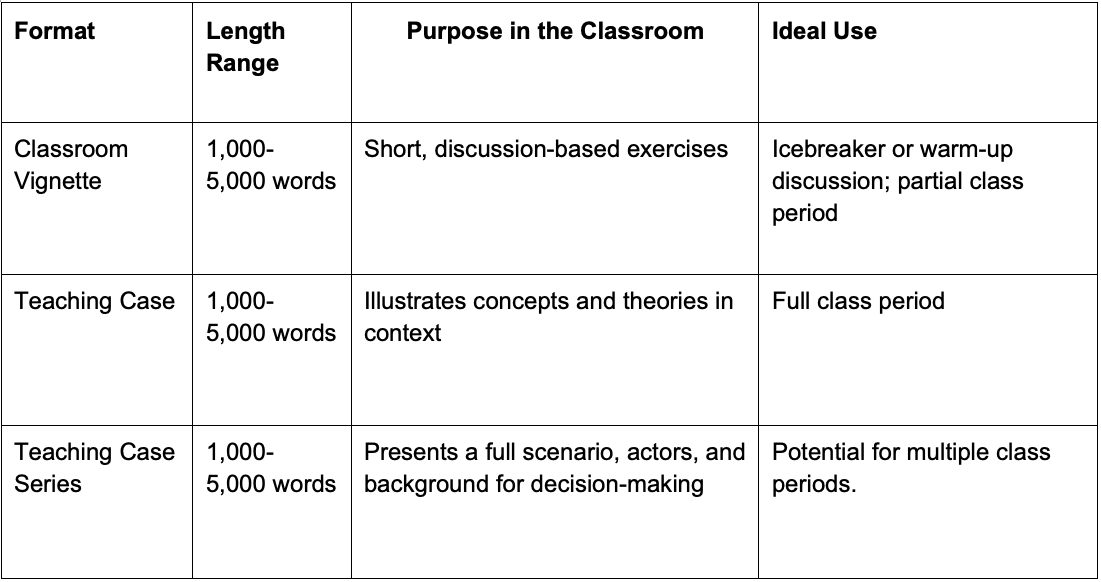
A teaching case should be between 1,000 and 5,000 words, including footnotes; appendices should be limited to approximately 2,000 words (a total of 10 pages). The Case Study Teaching Note should be no more than an additional 3,000 words. Authors may include an optional, shorter version in their case for use during a partial class period.
Make certain that there is no information identifying the author(s) in the Microsoft Word version of the submitted article.
All case studies submitted will have the following text appended on the front page: ”Case studies are intended as teaching tools for general issues, concepts, and strategies, and should not be seen as endorsements of specific management practices.”
Case studies should not focus on the author's personal opinion. The case should be designed to allow the reader to come to their own conclusions. The case author’s opinions may be included in the Case Study Teaching Note if they are pedagogically crucial to the lesson.
Faculty at research institutions should submit IRB approval for any studies or narrative aspects that fall under their institutional guidelines for human subjects research.
AJAM Case Studies are rooted in a philosophy of respect and ethical treatment of artists. Authors are encouraged to provide credit or co-authorship with artist collaborators and to seek grant-funded or other compensation for such collaborators whenever possible.
Authors are asked to consider the format, purpose, and use of their Teaching Case Study. Please see the table below for suggestions.
Case Study Teaching Note
An accompanying Teaching Note for each case is required and is an essential companion to any AJAM Teaching Case. The Teaching Note guides the instructor by offering insights and recommendations for effectively utilizing the case in instructional practice (i.e., in the classroom or online) and invites the case’s author to share specific goals for their activity, including key concepts, teaching strategies, tips, potential pitfalls, and relevant courses. Please limit the Teaching Note to 3,000 words.
The Teaching Note section often varies in structure as is appropriate for the case to which the note is attached. We have, however, included a suggested structure for authors below. Authors are encouraged to test and polish their case in a classroom setting before submission.
Title / Author
Relevant Courses, Audiences, and Learning Objectives
Key Concepts and Goals
Synopsis or Overview
Relevant Cultural Context (including local, community, and regional cultures)
Discussion Questions and Answers
Teaching Plan, Tips, and Strategy
Theory and Practice (additional sources of research in the field on key concepts covered in the lesson)
Epilogue (Did something significant happen after the end of the Case Study?)
Bibliography and Further Resources
Review and Publication Process
A full double-blind refereeing process is used that comprises the following steps.
Paper is sent to 2 reviewers for review. The reviewers' recommendations determine whether a paper will be accepted/accepted subject to change/subject to resubmission with significant changes/rejected. For papers which require major changes, the same reviewers will be used to ensure that the quality of the revised paper is acceptable.
If the paper is accepted by the reviewers, author(s) will be notified via email.
Author will be notified about the possible date of publication.
Copyright
Copyrights for articles published in AJAM are retained by the authors, with first publication rights granted to the journal. The journal/publisher is not responsible for subsequent uses of the work. It is the author's responsibility to bring an infringement action if so desired by the author.
References
Submission Form
Case Studies Editors
-

Susan Badger Booth
Emeritus Professor of Arts Management and Administration
Eastern Michigan University
-

Mark Clague
Professor of Musicology, American Culture, and Arts Leadership & Entrepreneurship
University of Michigan
-

Jeremy Peters
Assistant Professor of Music
Wayne State University